

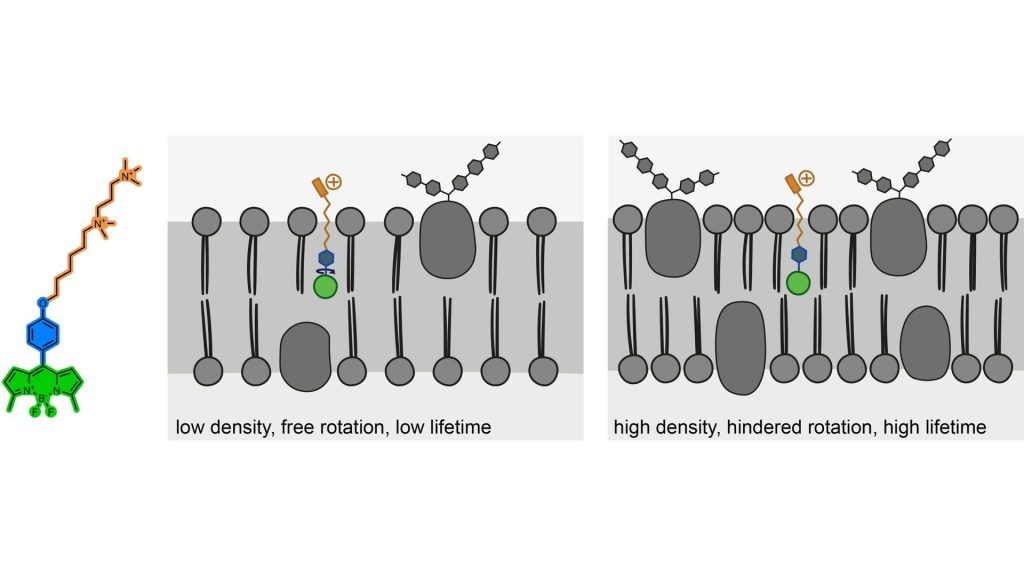
New publication from Joris Sprakel lab–Chemical Probes for Functional Plant Imaging. The work led by Maarten Besten was published in Annual Review of Plant Biology. Besten et al. highlight the advances in live functional imaging in plants through the use and development of chemical fluorescent probes, which enable plant functional imaging. They thoroughly explain how these chemical probes target, sense and report on functional features inside plant cells and tissues. Importantly, the authors also discuss the limitations of the probes and provide research examples on how these tools can complement biological studies to unravel the complex machinery that makes plants work. A must read if you are an imaging enthusiast! (The cover image on this post corresponds to CWP-BDP used to measure cell wall porosity in Arabidopsis pavement cells of the pectin-deficient (i) qua2-1 mutant and (ii) WT; and below an example of a rigidochromic fluorescent probe: N+-BDP ).
The rigidochromic membrane dye N+-BDP changes its fluorescence lifetime from low to high when the surrounding membrane density increases. When mechanical hindrance of the probe is minimal, the probe emits little to no light. By contrast, if the mechanical rotation is hindered by the immediate environment of the probe, for example, when it is inside a solid domain in a plasma membrane, the probe releases its energy by emitting fluorescence. The rotation mechanism thus couples the fluorescence of the probe to the mechanical features of its environment.
- Maarten Besten, Anna Daamen, Matyás Fendrych, Jan Willem Borst, Joris Sprakel. 2026. Chemical Probes for Functional Plant Imaging. Annual Review Plant Biology. 77:In press. https://doi.org/10.1146/annurev-arplant-063025-115246